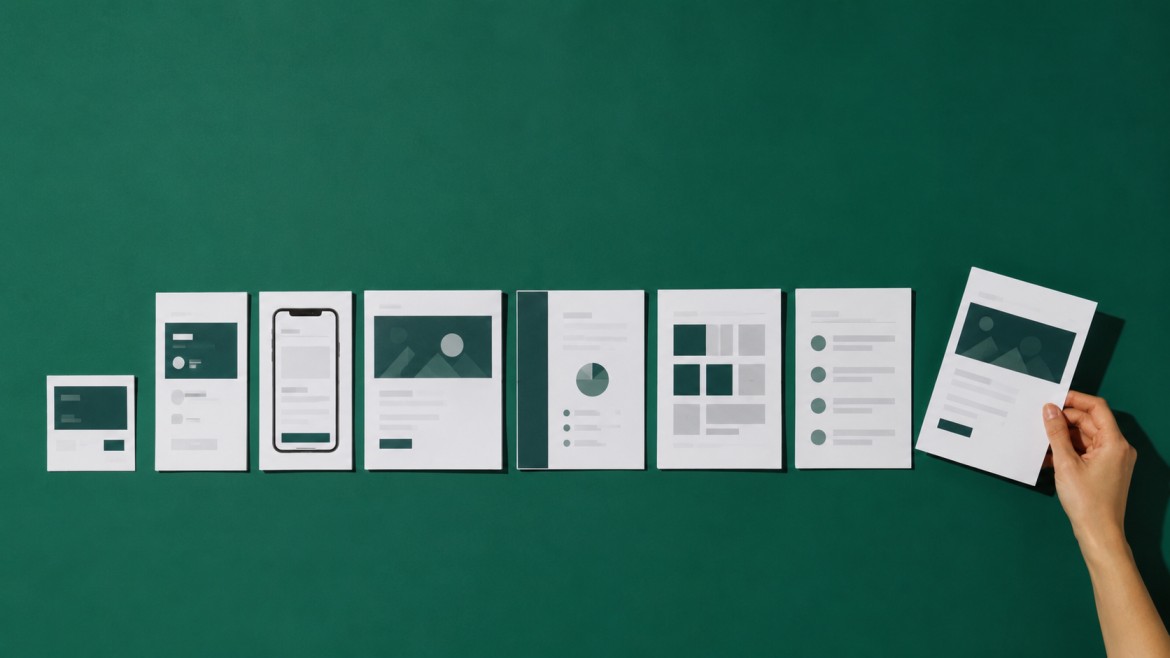
By now you’ve probably seen a design.md explainer. Google’s open spec for AI-readable design systems has been covered from a dozen angles since it launched: what it is, why Google built it, how the tokens map to existing standards.
That’s the easy version of the story. The more useful one, the one that actually changes how you should think about your design budget, is what teams are doing withdesign.md once they have one, and the part almost nobody’s saying out loud: the format everyone’s excited about isn’t neutral, and it isn’t finished.
The fast version, for anyone who missed it
A design.md file is a structured, machine-readable document that tells an AI tool how to make visual decisions for your product: brand tokens, spacing rules, component behavior, accessibility minimums, banned patterns, review steps. Instead of re-explaining your brand in every prompt, you point the model at one file. Google’s version follows the W3C Design Token Format and exports to a tokens.jsonthat’s compatible with Tailwind config, which is a real, practical reason adoption has been easy.
That’s the part that’s been explained everywhere. Here’s what’s actually new.
The real shift: design rules are becoming versioned company assets
The more interesting pattern showing up this month isn’t the file format. It’s what teams are building around it. Instead of writing a fresh prompt every time someone needs a landing page section or a deck slide, teams are packaging their design judgment into skill libraries: reusable, versioned sets of rules that a model can be pointed at repeatedly, the same way a codebase reuses a shared component library instead of rewriting a button from scratch every time.
One concrete example making the rounds: a marketing team built a shared “brand skill” that lets anyone on staff generate on-brand landing pages, data visualizations, and slide decks without looping in a designer for every asset. Individually, none of that skill file is exotic. It’s the same brand tokens, layout patterns, and content rules a design.md would hold. What’s changed is that it’s now treated like infrastructure: version-controlled, reviewed after every campaign, updated when something works, and reused instead of rebuilt.
That reframing matters more than the spec itself. A design.md file sitting unused in a repo is just documentation. A skill library that a team actually keeps current, and actually points every generation task at, is the thing that turns “AI made this look okay” into “AI made this look like us, reliably, every time.”
The part the explainers skip: this isn’t neutral yet
Here’s the sharper, less-covered angle. Google’s spec is genuinely open (Apache 2.0 licensed, published schema), but “open license” and “open governance” aren’t the same thing. Right now, the format’s evolution sits entirely with Google Labs. There’s no independent steering body the way there is for, say, the W3C or the OpenAPI Initiative. The tooling that makes design.md most useful today is also the tooling most tightly coupled to Google’s own design product, which still lacks some of the team-collaboration features (real-time co-editing, granular permissions, cross-project system management) that make an established design tool central to most product workflows.
None of that means design.md is a bad bet. It means treating it as the final answer would be premature. The realistic read: this becomes one format among a hybrid workflow, useful for the specification-and-handoff phase, coexisting with whatever tool your team already lives in for the parts it doesn’t cover yet, rather than a single spec that replaces everything else overnight.
What this actually means for a founder’s design budget
Strip away the format debate and there’s a genuinely useful operating idea underneath all of this: the winning move isn’t having a design.md file. It’s having a good rule system, wherever it lives.
That reframes the real question for anyone running a lean team. It’s not “should we adopt design.md.” It’s “who is actually writing, maintaining, and enforcing our design rules, and are they good enough that an AI tool following them produces something on-brand instead of something generic?”
Here’s what that question is worth in dollars. A senior product designer’s base salary in the US most commonly lands in the $170k–$180k or $220k–$230k range depending on market (Built In, 2026 data). Apply the roughly 1.3x multiplier employers typically use to account for benefits, payroll taxes, and overhead, and one senior hire runs a company somewhere around $220k–$300k a year, before recruiting time, before the risk of a bad hire, and before anyone’s actually enforcing a rule system on what that hire ships. That’s the real budget line design.md and skill libraries are trying to make more efficient.
Most non-designers building this way for the first time trip on the same root cause, dressed up as a dozen different symptoms: they treat the rule file as the deliverable instead of the review habit. A design.md with genuinely good rules still ships something broken if nobody checks the actual output against reality: an accessibility contrast ratio, a layout at 375px instead of 1440px, whether that “customer quote” is one you could stand behind if a real prospect asked where it came from.
The teams getting burned by this workflow aren’t usually the ones with weak rule files. They’re the ones who wrote a good file once, felt done, and stopped looking closely at what the model actually produced afterward.
The version of this DesignShare already runs
This is, in practice, the exact operating model behind DesignShare’s unlimited design subscription: a living set of brand rules and review standards, applied by a senior designer and a senior developer to every request, reused and refined across everything we ship for a client. That’s the substance of a skill library, minus the bet on which spec format wins. It’s the same theme running through how Figma’s AI agents are changing startup design and whether AI will actually replace designers: the tooling keeps compressing, the judgment layer doesn’t.
| DIY design.md / skill file | Senior team + AI workflow | |
|---|---|---|
| Setup effort | You write and maintain the rules | Rules built and maintained for you |
| Review loop | Self-managed, easy to skip under deadline | Built into every request by default |
| Format risk | Tied to whichever spec you pick | Tool-agnostic: outcome, not format, is the deliverable |
| Judgment on accessibility, mobile, proof | On you to catch | Checked before it reaches you |
| Cost | Your time, ongoing | One flat monthly rate, unlimited requests |
It’s the same reason one client, MdsyncNet, saw a 34% lift in trial-to-paid conversion off a redesign built this way. Not from a faster draft, but from someone senior checking that draft against real rules before it shipped. If you want that outcome without betting your design system on which AI vendor’s format wins next year, see the pricing or book 15 minutes to talk through what you’re building.