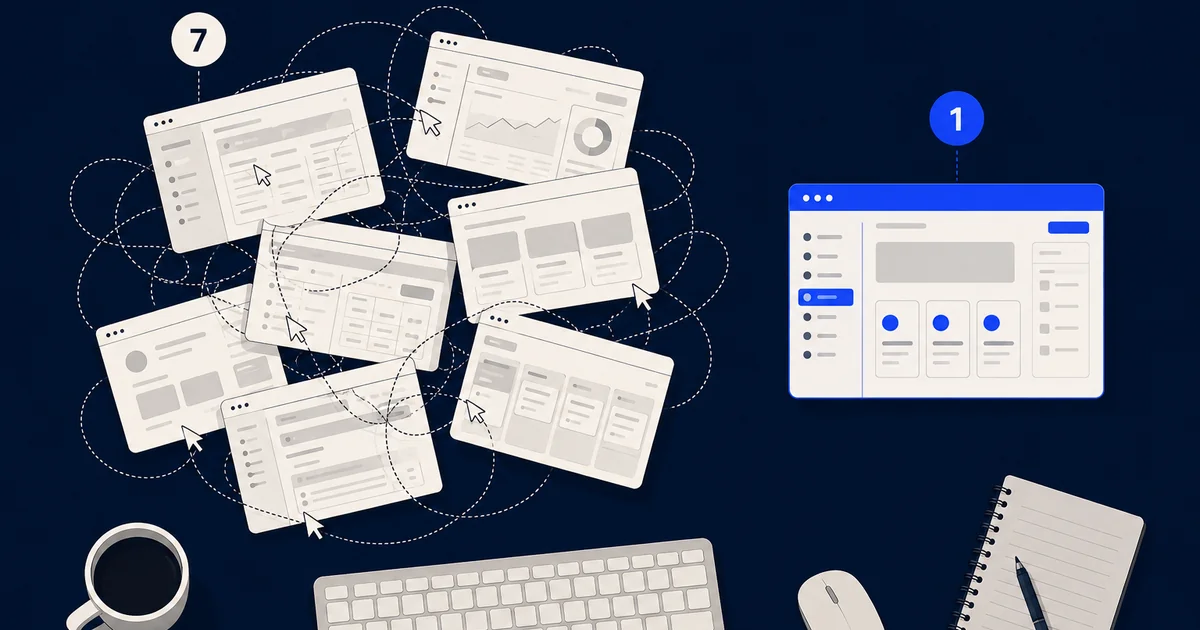
Do the 60-second audit below before you read the rest. It makes the whole post land differently.
Start here: count your tools
Open your password manager or your card statement. Count every design-adjacent AI tool your startup touched this quarter. The UI generator. The image model. The copy assistant. The prototyping tool with the new AI mode. The one your cofounder swears by. The one you signed up for during a launch week and forgot.
Got a number? Hold it.
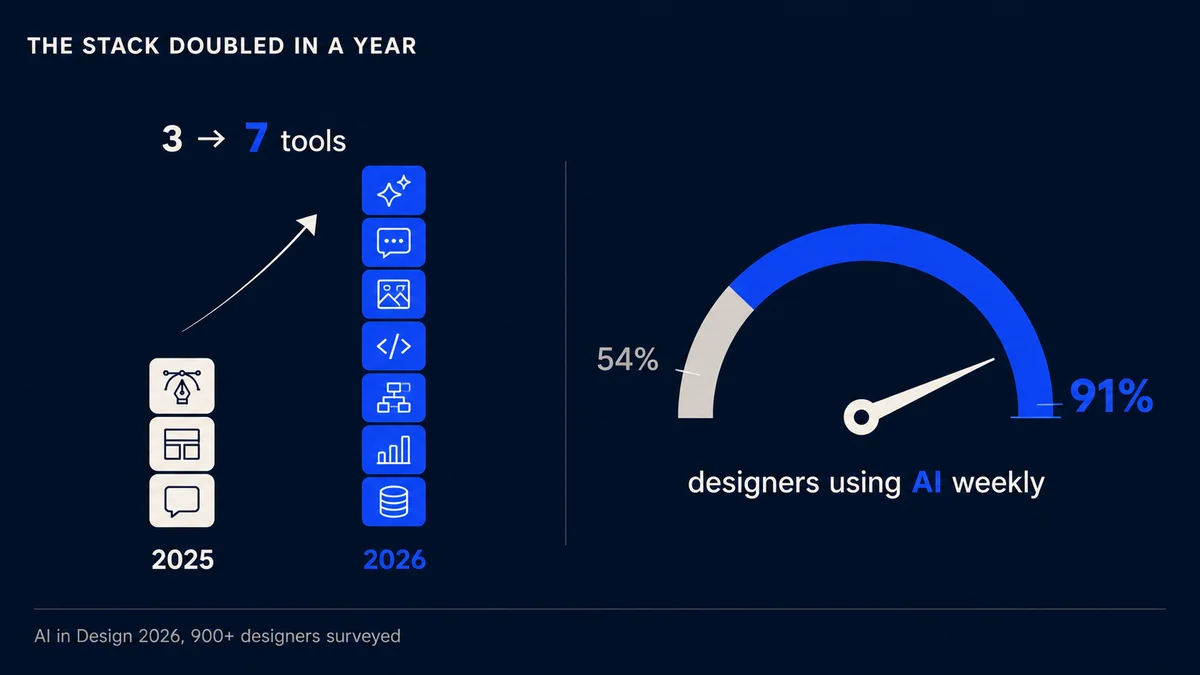
The "AI in Design 2026" research from Designer Fund and Foundation Capital, surveying 900+ designers, found the average design toolstack has more than doubled in a year, from 3 tools to 7. And 91% of designers now use AI at least weekly, up from 54% in 2025.
The average design toolstack more than doubled in a year, while weekly AI use jumped from 54% to 91% of designers.
So if your number was five, six, eight, you're normal. That's the problem.
The sprawl tax nobody invoices you for
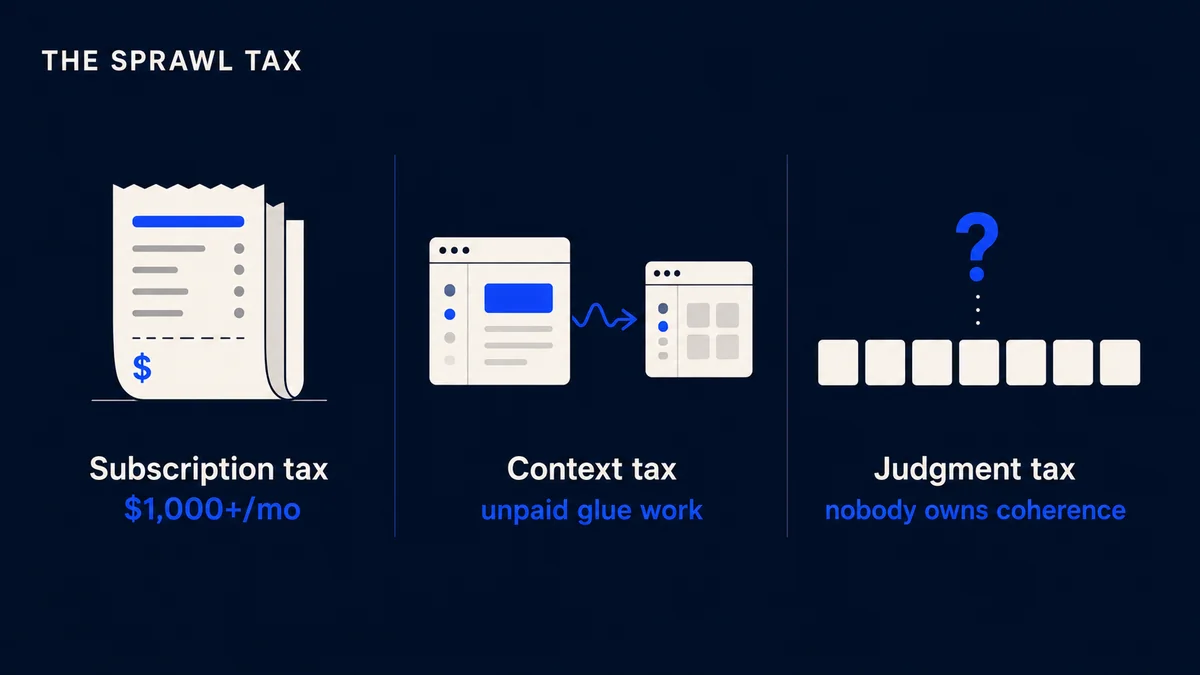
Each tool made sense the day you added it. Nobody plans a sprawl. It accumulates, and then it quietly starts charging you three ways.
The subscription tax. Seven tools at $20 to $200 a month each is $1,000+ a month before anyone has designed anything. I've reviewed startup stacks where the tooling bill rivaled a design retainer. The bill isn't the expensive part, though.
The context tax. Every tool has its own canvas, its own export quirks, its own idea of what a component is. Your landing page hero lives in one tool, the product screens in another, the brand assets in a third. Moving work between them is unpaid glue work, and it's usually the founder doing it at 11pm.
The judgment tax. This is the one that actually hurts. When output comes from seven different generators, nobody owns the question "is this right for us?" Each tool produces something plausible. Plausible is not the same as coherent. Your product starts looking like it was designed by seven different strangers, because it was.
I saw this coming from the inside. We flagged the sameness problem when we wrote about the anti-vibe-coding backlash: when everyone generates from the same models, output converges. Tool sprawl is the same disease at the workflow level. More generators, less signature.
Your scorecard
Be blunt with yourself. One point per "yes."
- 1Do you pay for two or more tools that do roughly the same thing?
- 2Has anyone shipped something to production that no senior person reviewed?
- 3Do your landing page and product UI look like different companies made them?
- 4Is there design work sitting unfinished because it's stuck between tools?
- 5Did you add a tool this quarter because of a launch video rather than a gap in your workflow?
Why tool #8 won't fix it
The reflex answer to a messy stack is a new tool that promises to unify everything. Figma is pushing hardest here, and to be fair, the ambition is real: their Weave workflows now pull 20+ AI tools into one canvas, and agentic features keep shipping monthly. I've covered what Figma's AI agents mean for startups before, and we use several of those features daily.
But notice what consolidation platforms actually solve: the context tax. The files sit closer together. What no platform solves is the judgment tax, because judgment isn't a feature. Someone still has to decide what your brand looks like, which generated draft survives review, and why. A unified canvas full of unreviewed AI output is just better-organized sprawl.
What compounds instead: three layers, one owner
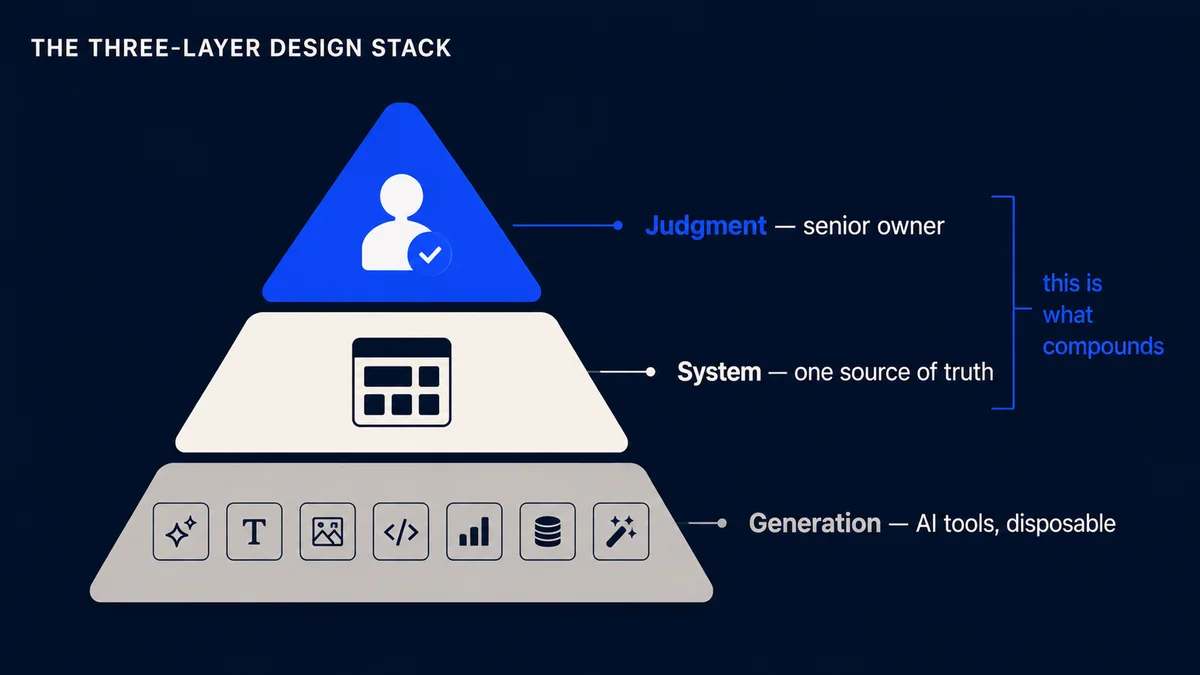
Here's how we run design internally, and how I'd tell any founder to structure it. Think in layers, not tools.
Layer 1 — Generation. AI tools, whichever are best this quarter. Interchangeable, disposable, cheap. Never load-bearing.
Layer 2 — System. One source of truth for your components, type, color, and voice. Everything generated gets pulled into this system or thrown away.
Layer 3 — Judgment. A senior human who owns coherence. One person or team accountable for the question "does this fit us?", with the authority to kill plausible-but-wrong output.
The tools in Layer 1 will be different next year. Layers 2 and 3 are what compound. When you buy design as a subscription, this stack structure is what you're actually buying: our team runs Layer 1 so you never think about it, maintains Layer 2 in Figma, Webflow, and Framer, and staffs Layer 3 with seniors who've shipped 315+ projects since 2017.
One flat fee, $3,495 a month, one active request at a time, about 48 hours per turnaround, pause whenever you like. The whole sprawl conversation becomes someone else's job. Here's what the subscription includes.